
Fast, Reliable Blown In Insulation Across Downtown Los Angeles
Blown in insulation in Downtown Los Angeles typically costs $1,800 to $4,200 for a standard loft or condo unit, with most jobs completed in a single day. That’s the honest range we quote, and we put it in writing before any work starts. If you’re in the Arts District, South Park, or the Historic Core, our crews know exactly what your building demands. Call (213) 376-3824 for a free estimate and a written price before we touch a single wall.
Downtown Los Angeles isn’t a typical insulation market. The buildings rise ten, twelve, twenty stories. The walls are concrete. The facades are protected terra cotta. And the units people actually live in? Most started life as bank headquarters, garment lofts, or office floors built between 1900 and 1930. Blowing insulation into those structures takes a different kind of knowledge than insulating a stucco bungalow in the Valley. We’ve been doing this work long enough to know which cavities hold surprises and which walls hide old conduit.
We dispatch from our Los Angeles office and keep crews scheduled for Downtown Los Angeles every business day. Response time to most buildings in 90013, 90014, 90015, and 90017 is same-day or next-day for estimates.
Why Aspen Attic Insulation Los Angeles Is Downtown Los Angeles’s Preferred Blown In Insulation Company
Our Downtown Los Angeles customers deal with building-specific headaches that generic insulation companies don’t understand. Adaptive reuse. Historic preservation rules. Condensation against massive concrete walls. We’ve worked inside the Eastern Columbia, the Rowan, and dozens of smaller loft conversions throughout the Historic Core and Fashion District. That local experience means we show up knowing what’s behind your walls before we drill the first test hole.
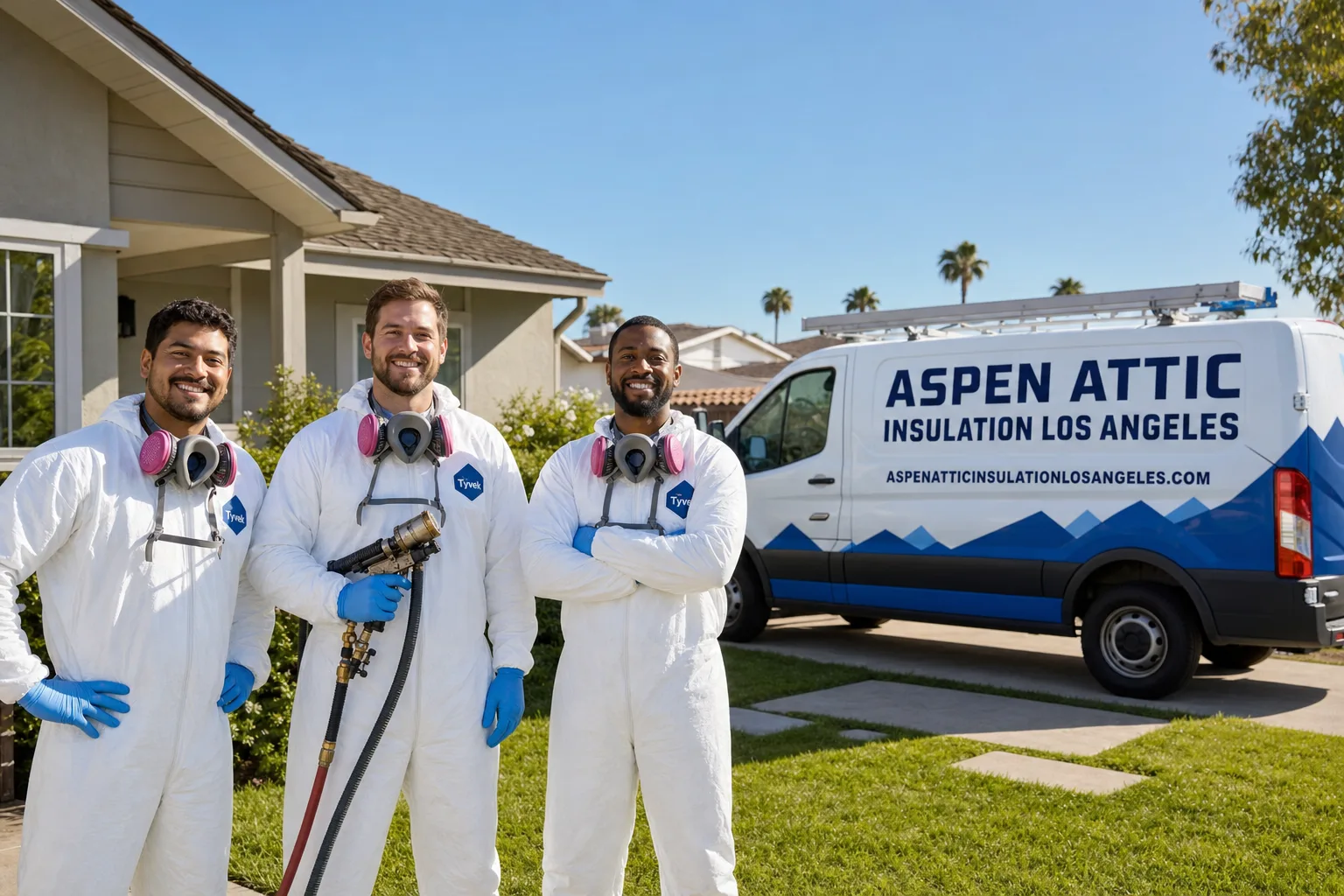
Garrett Sloane runs our Los Angeles operation, and he’s built the crew around a simple rule: the person we send to your loft has a name, a photo, and a background check you can see before they arrive. Every tech arrives in a clean marked uniform and shows a photo ID badge at the door. If anyone else shows up claiming to be from Aspen, the visit is free and we make it right. That’s the Threshold Standard, and it’s not optional.
Downtown Los Angeles homeowners tell us the same thing over and over: they wanted someone who would actually show up, actually answer the phone, and actually stand behind the work. Our Blown In Insulation jobs carry a 365-Day Done Right Promise in writing. If the insulation isn’t done right, we return and fix it free, covering labor and materials for a full year.
Blown In Cellulose Insulation in Downtown Los Angeles
Blown in cellulose insulation is the workhorse for Downtown Los Angeles loft conversions because it packs into irregular cavities better than anything else on the market. The material is loose recycled paper fiber treated for fire resistance, blown through a hose into wall voids, floor cavities, and ceiling bays. In a Historic Core building, those voids are almost never uniform. Old commercial plumbing chases, abandoned electrical runs, and original brick coursing create gaps that no batt could ever fill. Cellulose flows around the obstacles and compacts into a dense, continuous thermal layer.
A typical Downtown Los Angeles loft unit with 800 to 1,200 square feet of wall and ceiling area runs $1,900 to $3,600 for GreenFiber or Johns Manville cellulose, depending on cavity depth and access. That includes drilling, blowing, patching, and cleanup.
Dense Pack for Adaptive Reuse
In concrete and masonry buildings, we dense-pack cellulose at a higher pressure than standard attic work. This approach fills voids completely and reduces settling over time. For buildings where the facade can’t be touched, we drill from the interior through drywall or furring strips, blow the cavity, then patch and repaint to match. The process preserves every square foot of living space, which matters when lofts in South Park sell for over $800 a square foot.
Cellulose for Sound Control Between Units
Nothing quiets a neighbor’s subwoofer like a dense-packed cellulose wall. In high-rise lofts with shared demising walls, we pack cellulose at 3.5 pounds per cubic foot to add an acoustical barrier that also cuts heat transfer. Buildings built for commercial use were never designed for residential acoustic separation, and cellulose is the most cost-effective retro-fit we can blow into those walls without removing existing drywall.
Blown In Fiberglass Insulation in Downtown Los Angeles
Blown in fiberglass insulation makes sense in Downtown Los Angeles when you need dry, lightweight coverage that won’t hold moisture against a concrete wall. The material is spun glass fiber blown loose into cavities, valued less for its density than for its resistance to water absorption. In a building with cool concrete thermal mass and coastal humidity pressing in from the west, that matters. Wet cellulose against a masonry wall is a mold risk. Fiberglass doesn’t feed mold and drains moisture back out.
A Downtown Los Angeles loft with 1,000 square feet of ceiling or floor area typically runs $1,500 to $3,200 for Owens Corning or Knauf blown fiberglass. The lower end applies to open attic-style ceilings in newer penthouse additions; the upper end covers wall retrofits in older masonry shells.
Fiberglass for Ceiling and Floor Bays
Penthouse units in Downtown Los Angeles often have flat roofs directly above the ceiling, and those bays heat up fast in August. We blow fiberglass to R-38 or R-49 in those ceiling cavities to stop solar gain from cooking the living space below. The material stays put, adds no meaningful weight to a roof deck, and installs in a single afternoon.
Moisture-Safe Retrofits Against Concrete
For interior stud walls built over original concrete, we often recommend fiberglass instead of cellulose. The concrete sweats in humid weather, and fiberglass breathes. We also pair it with proper vapor management on the warm side of the wall so condensation doesn’t collect inside the cavity. This is the kind of detail that a generalist insulation crew misses and a Downtown Los Angeles homeowner pays for later.
Trusted Brands We Service in Downtown Los Angeles
We stock GreenFiber, Owens Corning, and Johns Manville products for most Downtown Los Angeles jobs, and we keep a local supply on hand for fast turnaround when a building deadline hits. Material choice gets matched to the job, not the inventory we’re trying to clear. For dense-pack cellulose in irregular masonry cavities, we use GreenFiber most often. For moisture-sensitive applications against concrete, Owens Corning fiberglass. For acoustic walls between units, Johns Manville. If your building’s spec calls for a specific product, we quote it exactly and show you the material cost in writing before work begins.
Common Blown In Insulation Problems We See in Downtown Los Angeles Homes
- Settled insulation leaving thermal bridges in tall walls. In concrete buildings with irregular voids, loose-fill insulation can settle over years, leaving cold bands near the ceiling and warm bands near the floor. We see this most often in buildings along Broadway and Spring Street where original plumbing chases were never properly filled. The fix is dense packing the entire cavity under pressure.
- Mold growth behind interior stud walls. Coastal humidity drifts into Downtown Los Angeles from the west, and when dense blown cellulose sits against a cool concrete wall without a proper vapor barrier, it can hold moisture and grow mold behind the drywall. We regularly open these walls in lofts near the 10 and 110 freeways and find the problem hiding behind a fresh coat of paint.
- Condensation on interior furring strips. Massive concrete and terra cotta walls stay cool year round. When warm interior air hits them through uninsulated pockets, condensation forms on the furring strips holding your drywall. The water drips, the metal corrodes, and the paint bubbles. We fix this by blowing the cavity completely and sealing air leaks before any finish work goes back.
- Illegal exterior drilling on protected facades. We’ve seen crews from other companies drill through terra cotta without checking preservation rules first. Downtown Los Angeles is packed with buildings under Mills Act contracts or local historic protections, and drilling into a protected facade can trigger fines and expensive repairs. We always work from the interior on protected buildings and coordinate with building management on any exterior access. If your building has preservation restrictions, call us before anyone picks up a drill.
Pricing for Blown In Insulation in Downtown Los Angeles, CA
In Downtown Los Angeles, blown in cellulose for walls runs $2.50 to $4.75 per square foot installed, and blown fiberglass runs $2.00 to $3.75 per square foot installed. A typical 900-square-foot loft with both wall and ceiling work lands between $2,100 and $3,900 all in. What moves the price: cavity depth, building access, whether we’re drilling through drywall or masonry, how much old material needs removing, and whether the facade is protected by preservation rules. Tall buildings with freight elevator scheduling and restricted work hours cost more than low-rise structures. Every quote is written before work starts, with no post-job surprises. Call (213) 376-3824 for a free estimate, and we’ll send someone with an infrared camera to map your walls before we quote a single square foot.
Quick Pricing Table
| Job Type | Price Range |
|---|---|
| Wall cavity dense pack (per sq ft) | $2.50 – $4.75 |
| Ceiling or floor bay (per sq ft) | $2.00 – $3.75 |
| Typical 900 sq ft loft, walls + ceiling | $2,100 – $3,900 |
| Moisture remediation add-on (per cavity) | $150 – $400 |
We Also Serve Cities Near Downtown Los Angeles
Our crews cover Downtown Los Angeles daily, and we run jobs in the surrounding areas as well. The same written pricing and 365-Day Done Right Promise apply in Los Angeles, West Hollywood, Santa Monica, and South Gate. If you’re just outside the Downtown core and need blown in insulation, call us and we’ll schedule an estimate the same week.
Serving Downtown Los Angeles, CA - Our Local Coverage Area
We’re based in the Downtown Los Angeles area and know this community well. Use the map below to see our service coverage - if you’re nearby, we can almost certainly help.
FAQs About Blown In Insulation in Downtown Los Angeles
Blown-in insulation won’t fix the windows themselves, but it dramatically cuts the air leakage around them. In Downtown Los Angeles loft buildings with original steel sash windows, we blow insulation into the wall cavities immediately surrounding the window frames and then seal the perimeter gaps with a flexible spray foam like Demilec. That stops the draft that makes single-pane windows feel so cold in January and so hot in August. The combination gets most lofts through Title 24 energy requirements without replacing the windows, which most Historic Core buildings won’t allow anyway. Call (213) 376-3824 and we’ll inspect the window perimeters during your free estimate.
Into the interior wall cavities, never the structural concrete itself. Most Downtown Los Angeles lofts have interior stud walls built eight to twelve inches inside the original masonry or concrete shell, and that gap is where we blow. For walls where furring strips sit directly on masonry, we dense pack the space between the strips. For ceilings, we use the existing ceiling cavity or build a dropped soffit if there isn’t one. The floor above or below also gets treated in many units, because sound travels through concrete slabs almost as easily as through air.
Yes, we fix it. Settling happens when loose-fill was blown into a tall wall without the proper pressure, leaving air pockets that collapsed over time. In Downtown Los Angeles buildings, we see this most often in walls higher than ten feet or in cavities with irregular shapes that the original installer filled too quickly. We re-blow the wall using a dense-pack technique that compacts the material to a high density and locks it in place. The process takes most of a day for a single wall, and the repair is covered by our 365-Day Done Right Promise if we touched that cavity originally.
No, when installed properly from the interior. Cellulose is inert, and it doesn’t chemically react with brick, concrete, or terra cotta. The risk to historic facades comes from drilling through the exterior, which we never do on a protected building without written permission from building management and the city. We work from the inside, drilling through drywall or furring, and the original masonry stays untouched. If your building has preservation restrictions, tell us during the estimate so we can verify the approach with management before any work starts.
Dense-packed cellulose is the best option for walls you want to keep as walls. It adds mass and seals the small air gaps that carry sound between units. We blow it at a high density specifically for acoustical separation, and most Downtown Los Angeles customers notice the difference within the same day. For floors and ceilings, blown fiberglass dampens footfall and overhead noise well, especially when paired with an acoustical underlayment. If noise is your main concern, call (213) 376-3824 and we’ll assess the specific wall and floor construction in your unit and quote the right material for the job.
Call Aspen Attic Insulation Los Angeles for Downtown Los Angeles Blown In Insulation
If you’re in Downtown Los Angeles and you want blown in insulation done right, with a written price, a named tech, and a 365-day guarantee, call us at (213) 376-3824. Estimates are free. A live person answers the phone day or night.
Written by Garrett Sloane, Owner at Aspen Attic Insulation Los Angeles, serving Downtown Los Angeles since 2002.