
Fast, Reliable Spray Foam Insulation Across Santa Monica
Spray foam insulation in Santa Monica requires a different approach than inland cities. The marine layer that rolls in most mornings deposits salt and moisture on every exterior surface, including inside unsealed wall cavities. Closed-cell foam handles this. Open-cell foam often doesn’t. That single distinction drives most of our recommendations for homes here, and it’s why we send a written price before any work starts. When you call (213) 376-3824, a live person answers, not a voicemail tree.
If you’re in a 1920s duplex near Ocean Park or a 1960s apartment building off Pico Boulevard, the walls likely have zero insulation or fiberglass that’s been shoved around by decades of roof repairs. We know what that looks like because our crews see it weekly. We’re the Spray Foam Insulation team that puts the technician’s name and photo in writing before anyone shows up at your door. That matters when you’re home alone or have young kids and don’t want a stranger knocking without warning.
Why Aspen Attic Insulation Los Angeles Is Santa Monica’s Preferred Spray Foam Insulation Company
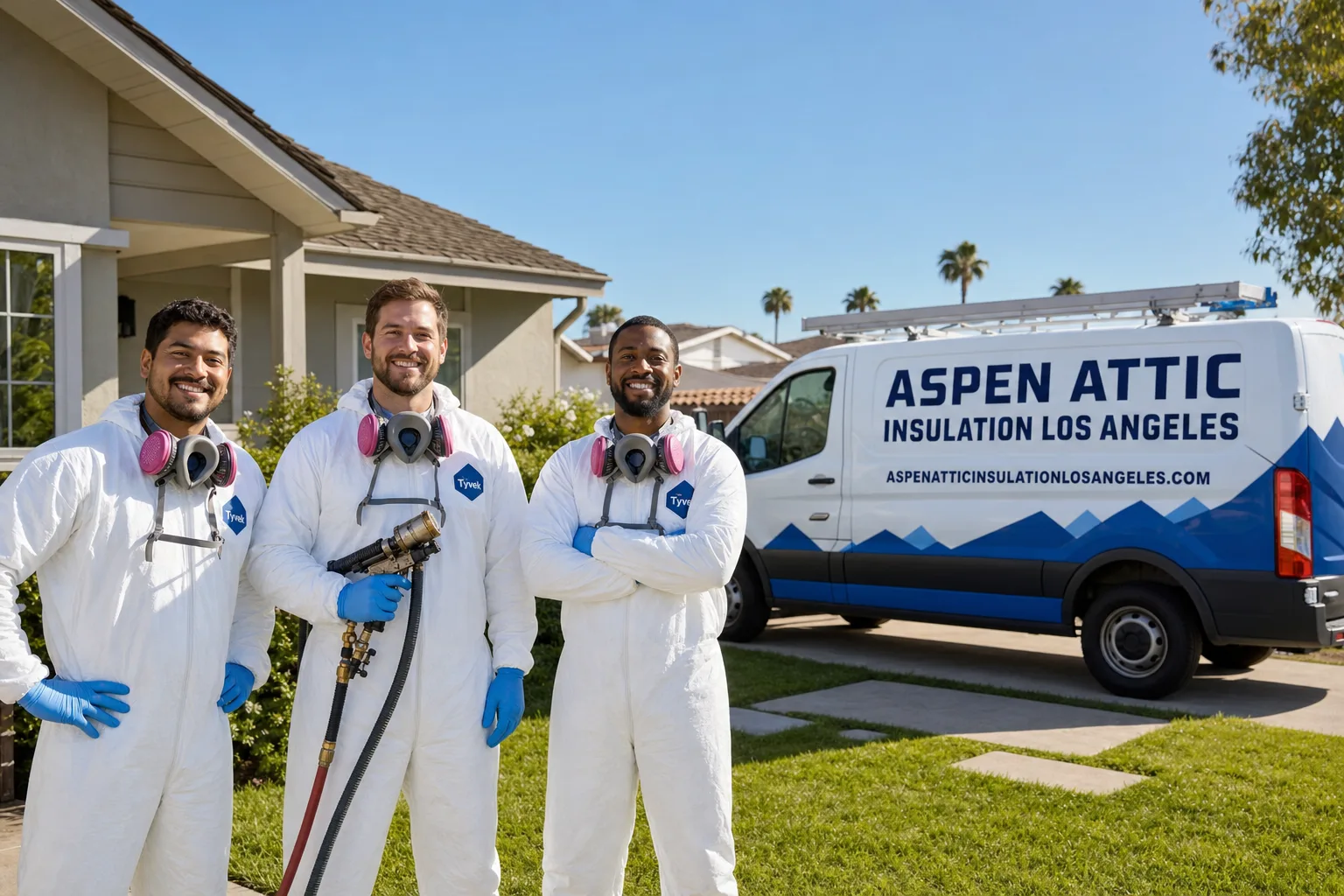
Santa Monica homeowners call us because we don’t hide behind a dispatch center. Garrett Sloane runs this operation with a simple rule: the person whose name is on the invoice is the person who shows up, in a marked uniform, with a photo ID badge. Before your appointment, you get the tech’s name and photo. If someone else arrives, that visit is free. We call it the Threshold Standard. It’s how we’ve worked since 2002.
Our Santa Monica customers face a specific problem: older buildings, strict local energy codes, and salt air that punishes the wrong insulation choice. When someone in the Wilshire-Montana neighborhood or the Sunset Park district calls about a hot top-floor unit, we know to check for the marine-layer overheating pattern, not just inadequate R-value. That local knowledge means fewer return visits and fewer surprises. Every job carries a 365-day written guarantee covering labor and materials. If something isn’t right, we come back and fix it. Free.
Spray Foam Insulation Contractors in Santa Monica
Spray Foam Insulation Contractors in Santa Monica work with two realities: pre-1980 building stock and a coastal climate that punishes mistakes. The job here typically involves sealing rim joists, wall cavities, and attic boundaries with closed-cell foam rated for high-humidity, salt-air exposure. Open-cell foam, which works fine in dry inland attics, can absorb marine-layer moisture and lose R-value within a decade here. That failure mode is common in Santa Monica and rare in cities just five miles east.
When a homeowner calls us about a drafty 1940s bungalow near Main Street, we start with a visual inspection of the existing air-sealing. Then we write a price. Not a range. Not a verbal estimate. A written number before any work begins. Typical spray foam contractor work in Santa Monica runs $2,800 to $7,500 depending on square footage, access, and whether we’re doing full walls or just rim joists.
Closed-Cell Wall Cavity Work
For uninsulated wood-frame walls, closed-cell foam is the standard here. It adds structural rigidity, blocks moisture, and hits the R-values Santa Monica’s reach code expects for retrofit work. We match the foam to the substrate, not the other way around. Our crews carry Demilec and Icynene products because both have formulations built for coastal humidity.
Rim Joist Sealing in Older Buildings
Rim joists in 1920s and 1930s buildings are often completely unsealed, letting salty air move through the floor system. Sealing them with closed-cell foam stops that air movement and keeps crawlspace moisture out of living spaces. It’s a smaller job, usually $1,200 to $2,800 in Santa Monica.
Spray Foam Attic Insulation in Santa Monica
Spray Foam Attic Insulation in Santa Monica solves a problem you can feel by 2 p.m. The morning marine layer burns off, the sun hits the roof, and top-floor rooms spike ten degrees in an hour. Many older apartment buildings here have only a thin layer of displaced fiberglass between the ceiling and the roof deck. It isn’t enough, and it usually isn’t even in the right place anymore. We remove it, air-seal the attic floor or roofline, and install foam that stops the heat transfer.
Attic jobs in Santa Monica run $3,200 to $8,000 for a typical single-family home or duplex unit. The variance comes from roof pitch, access, and whether you want the attic floor sealed or the roofline insulated as a conditioned space. We’ll write the price before we touch anything. No surprises after the fact.
Roofline Conditioning for Top-Floor Units
When the attic is part of the living space or houses the HVAC system, we spray the underside of the roof deck with closed-cell foam. This creates a conditioned attic that stops the midday heat spike and protects ductwork from the salty air. It’s the right fix for top-floor overheating in Santa Monica’s rent-controlled apartment buildings, but it costs more than floor-level work.
Attic Floor Air-Sealing for Older Homes
For homes where the attic is just storage or empty space, we seal the floor plane and rim joists, then add foam to a depth that meets or exceeds the city’s reach code requirements. This is the more budget-conscious option and works well when the ceiling below has never been properly isolated from the attic.
Trusted Brands We Service in Santa Monica
We stock local inventory for Santa Monica jobs using Owens Corning, Johns Manville, and Demilec products. Demilec’s closed-cell HFO-blown foam is our default for coastal wall cavities because it holds up against salt-air moisture. When a customer asks about fiberglass alternatives, we’re honest: Johns Manville blown-in can work for attics, but walls in the coastal zone get foam. We keep these materials in our Los Angeles warehouse and bring them to Santa Monica same-day. No waiting on a distributor.
Common Spray Foam Insulation Problems We See in Santa Monica Homes
- Open-cell foam absorbing marine-layer moisture. In poorly vented attic knee walls and wall cavities on the west side of buildings, open-cell foam takes on salty moisture and loses R-value. Within eight to ten years, it can be performing at half its original rating. We see this constantly in buildings within half a mile of the beach.
- Expanding foam cracking plaster keys in pre-1980 stucco walls. High-lift-rate foam expands fast enough to crack brittle plaster in 1920s through 1970s construction. We drill relief holes and control lift rates. Low-bid crews usually don’t, and the homeowner finds hairline cracks spreading across interior walls within a year.
- Spraying over knob-and-tube wiring in older attics. Santa Monica has a lot of original knob-and-tube. Encasing it in foam traps heat and can break down the cloth insulation. Our crews inspect for this first. If it’s present, we flag it and coordinate with an electrician before we spray anything.
- Displaced fiberglass from decades of roof repairs. Roofers push aside attic insulation to access the deck, and it never gets put back. We find whole sections of attic floors bare while fiberglass is piled against the eaves. That’s why top-floor units get so hot after the marine layer clears.
Pricing for Spray Foam Insulation in Santa Monica, CA
We Also Serve Cities Near Santa Monica
Beyond Santa Monica, our crews handle spray foam work in West Hollywood, Gardena, Los Angeles, and South Gate. If you’re in one of those areas and need the same written-price, named-technician standard, Santa Monica-area homeowners point their neighbors to us regularly. Same material inventory, same guarantee, same background-checked crew protocol.
Serving Santa Monica, CA - Our Local Coverage Area
We’re based in the Santa Monica area and know this community well. Use the map below to see our service coverage - if you’re nearby, we can almost certainly help.
FAQs About Spray Foam Insulation in Santa Monica
Do Santa Monica’s coastal building codes require vapor barriers with spray foam in uninsulated pre-1980 walls?
No, but closed-cell spray foam at two inches or more acts as its own vapor barrier, which satisfies the moisture-management intent of the city’s reach code. Santa Monica’s local amendments exceed Title 24, and inspectors here generally accept closed-cell foam as both insulation and air barrier. Open-cell foam does not qualify as a vapor barrier, which is another reason we recommend closed-cell for wall cavities in this climate zone. Call (213) 376-3824 and we’ll walk through what your building needs.
Can spray foam be safely installed in a 1920s Santa Monica attic with original knob-and-tube wiring?
No. It is not safe to encase live knob-and-tube wiring in spray foam. The foam traps heat around the old cloth-insulated conductors and can accelerate insulation breakdown, which is a fire hazard. In Santa Monica’s aging duplex stock, we occasionally find this. Our policy is to flag the wiring, pause the insulation work, and bring in a licensed electrician to address it before we spray. We will not compromise on this, and no legitimate contractor should either.
How does spray foam handle the salty air near Santa Monica Beach better than fiberglass in old wall cavities?
Closed-cell spray foam is a moisture barrier. Salt-laden air in Santa Monica moves through wall cavities and condenses on cool surfaces, which is how fiberglass gets damp, sags, and loses its R-value. Closed-cell foam stops that air movement completely, which keeps the wall dry and the insulation performing. That’s why we use Demilec closed-cell formulations for any wall work within a mile of the beach.
Will spray foam in our Santa Monica attic keep top-floor rooms cooler when the morning marine layer burns off?
Yes. The heat spike in top-floor Santa Monica units comes from solar gain on the roof deck radiating into the attic and then through the ceiling. Closed-cell foam under the roof deck stops that radiant transfer before it reaches the living space. Our customers in apartment buildings near Montana Avenue and Wilshire Boulevard report top-floor temperatures dropping five to eight degrees after roofline insulation, even on clear afternoons.
Does spray foam in a 1950s Santa Monica duplex need special fire protection under the city’s local amendments?
Yes. Santa Monica’s local amendments generally require a thermal or ignition barrier over spray foam in occupied spaces, and in some cases an intumescent coating on exposed foam in attics and crawl spaces. For a 1950s duplex, the attic access and any exposed wall cavities will likely need a coating. We include that in the written price, not as a surprise add-on. Call (213) 376-3824 for a walkthrough and exact quote.
Contact Us for a Free Spray Foam Estimate in Santa Monica
If you’re tired of top-floor heat, drafty walls, or energy bills that don’t match the mild climate, call (213) 376-3824. You’ll get a live person, a scheduled walkthrough, and a written price before any work starts. You’ll also get the name and photo of the technician who will arrive, in a marked uniform, with a photo ID badge. That’s how we’ve operated since 2002, and it’s the only way we’ll work in Santa Monica. Serving all Santa Monica neighborhoods including Ocean Park, Sunset Park, Wilshire-Montana, and the Pico district.
Written by Garrett Sloane, Owner at Aspen Attic Insulation Los Angeles, serving Santa Monica since 2002.